🤖 Turn AI Content Into Income
💰 Build and monetise AI-powered content systems that generate real online income through freelancing, digital products, and online platforms.
🤖 Turn Simple AI Content Into Real Income Streams—Even if You’re Starting from Scratch.
The Income Expansion Path is where freelancing evolves into scalable digital income. Instead of trading time for money, you begin building assets like digital products, guides, and automated content systems that can generate income over time.
This approach focuses on using AI tools to create content, package it into simple products or services, and turn it into structured income streams—without needing advanced skills, an audience, or complex systems.
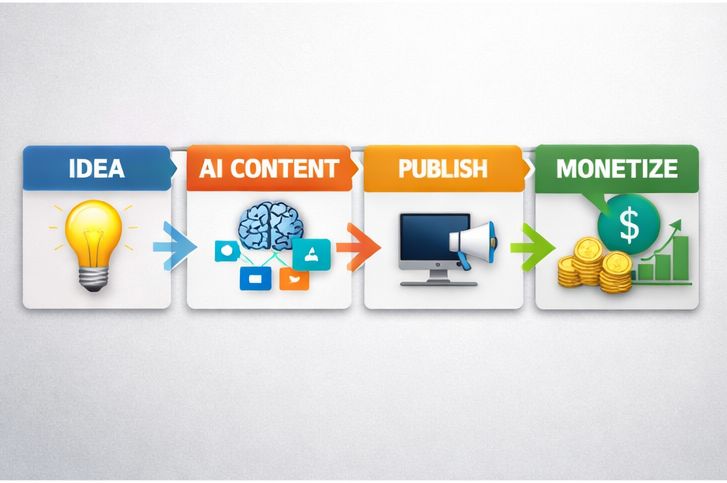
You’ll learn practical, beginner-friendly workflows that take you from idea → content → monetisation, and help you build income streams that can grow and scale over time.
🤖 AI Content Creation & Monetisation:
Turn simple skills into income using scalable AI systems.
AI content creation is not about posting more or chasing algorithms—it’s about building useful, sellable digital assets that solve real problems and generate income through repeatable systems.
With AI, you can move from idea → content → monetisation faster than ever before, without needing advanced technical skills, a large audience, or years of experience.
These systems allow you to turn everyday knowledge into digital products, services, and content assets that can be reused, scaled, and monetised over time.
This section breaks down the core methods, focus areas, and practical systems used to turn AI-generated content into consistent income streams.
✍️ What AI Content Creation Really Means (And Why It Pays)!
AI content creation is the process of using AI tools to create, improve, and scale digital assets such as content, templates, guides, prompts, and full digital products.
But the real value is not the tools—it’s the outcome.
AI allows one person to produce high-quality digital work at scale, turning ideas into reusable assets faster than ever before. When content is treated as something that can be sold, reused, or packaged, it becomes income-producing inventory instead of one-off effort.
That’s why it works.
Instead of trading time for money, AI content creators focus on:
- Creating once and selling multiple times.
- Packaging knowledge instead of trading hours.
- Building simple systems that scale over time.
This approach makes AI content creation one of the most accessible ways for beginners, freelancers, and solopreneurs to build income without relying on constant client work or daily posting.
🗺️ Your AI Content & Digital Products Learning Path:
Follow this structured path to move from beginner → income using AI content systems:
- Start here: AI Content Creation Jobs for Beginners
- Understand the system: The AI Content Workflow Explained
- Avoid burnout: Why Content Volume Hurts Your Growth
- Work faster: Creating Content Efficiently With AI
- Monetise: How to Make Money With Digital Products
- Expand: 5 Ways to Sell Your Own Digital Products
- Scale: Build a Profitable Digital Product Business
- Beginner recap: Simple Ways to Start Selling Online

💸 Best Types of AI Content to Monetise:
Not all AI content makes money. The most successful content focuses on usefulness, repeatability, and clear outcomes—not volume or creativity alone.
The highest-performing AI content usually falls into a few core categories:
✍️ Written Content Assets.
AI can be used to create structured written assets such as guides, checklists, email sequences, reports, prompt packs, and frameworks. These work because they solve specific problems and can be packaged and sold as digital products.
- Outcome-focused rather than purely educational.
- Built for a specific audience or use case.
- Easy to reuse, customise, or bundle.
🎨 Visual and Design-Based Content.
AI design tools make it easy to create templates, social media assets, planners, and branded graphics without design experience. These perform well because they save users time and effort.
- Canva templates.
- Pinterest pin packs.
- Lead magnet designs.
- Presentation and ebook layouts.
🧩 Templates, Systems, and Frameworks.
Templates are high-value AI assets because they remove thinking and reduce execution time. AI can generate workflows, scripts, prompts, and systems that users can apply immediately.
- Business templates.
- Content systems.
- Prompt libraries.
- Swipe files.
🎓 Educational and Instructional Products.
AI can help you quickly create mini-courses, guides, and tutorials. These products build trust and long-term value when they are clear, practical, and easy to follow.
Clarity beats length and production quality.
💼 Service-Based AI Content.
Some AI content is best monetised through services such as drafts, outlines, audits, and research. In this model, AI acts as a delivery engine—helping you work faster, serve more clients, and increase profitability.
The common thread: the clearer the problem and outcome, the easier the content is to monetise.
👉 Want to turn this into real clients?
Start with this AI Freelancing Guide
🚀 Turning Skills You Already Have Into Sellable Content:
Most people underestimate how valuable their existing skills already are.
You don’t need expert-level knowledge to make money with AI—you need clarity, structure, and packaging.
Any skill that helps someone save time, reduce effort, or achieve a better result can be turned into sellable content. AI simply speeds up the process.
Common skills that work well include:
- Writing, editing, or research.
- Basic design or layout.
- Organisation and planning.
- Teaching or explaining processes.
- Industry or job-specific experience.
The key shift is simple:
Stop only doing the work → start documenting the process.
When you document your process, you move from delivering custom work every time to building reusable assets that can be sold repeatedly.
For example, AI can help you:
- Turn experience into checklists, guides, or templates.
- Convert rough notes into structured digital products.
- Refine ideas into polished, usable assets.
- Package workflows into repeatable systems.
This approach is especially powerful for beginners and freelancers because it removes the need to constantly trade time for income. Once created, these assets can be reused and sold multiple times.
The opportunity: You don’t need to learn something new—you need to turn what you already know into income-producing assets.
🛠️ AI Tools That Speed Up Content Creation (Without Killing Quality).
AI tools work best when they support your thinking—not replace it. The goal isn’t automation for the sake of speed. It’s creating content faster without losing clarity, usefulness, or trust.
Most effective AI content systems are built around a small, focused stack that handles ideation, structuring, refinement, and formatting.
✍️ AI Writing and Research Tools:
These tools help generate outlines, drafts, summaries, and rewrites. They’re ideal for turning rough ideas into structured content and improving clarity across longer projects.
The key is guided creation—you provide direction, context, and constraints so the output stays relevant and useful.
🎨 AI Design and Visual Tools:
Design tools make it possible to create templates, product visuals, and branded assets without advanced design skills or outsourcing.
They’re best used for:
- Templates and frameworks.
- Product layouts and covers.
- Maintaining visual consistency.
🧩 AI Organisation and Workflow Tools:
AI can also support your workflow behind the scenes—helping you organise ideas, plan content, and break projects into manageable steps.
This reduces friction and keeps you moving, especially when building multiple assets or working on long-form content.
⚙️ Use AI as a System—Not a Shortcut:
The biggest drop in quality happens when AI is used as a shortcut.
High-performing creators use AI as a collaborator—refining inputs, reviewing outputs, and applying judgment where it matters.
Used correctly, AI increases output without reducing value, making it possible to scale content creation while maintaining trust.

✈️ Monetisation Models That Actually Work:
Monetising AI-generated content works best when you focus on simple, proven models—not complex funnels or aggressive sales tactics.
The goal is to turn useful content into income with minimal overhead and maximum flexibility.
📦 Digital Products.
Digital products are one of the most effective ways to monetise AI content. AI makes it easy to create guides, templates, prompt packs, planners, and toolkits that can be sold repeatedly.
They work because they:
- Scale without additional effort.
- Require no ongoing delivery.
- Can be bundled, upgraded, or expanded over time.
🧑💻 AI-Powered Services.
AI can also be used to deliver services faster and more efficiently. Instead of selling time, you sell structured outputs and systems while AI handles most of the production work.
Examples include:
- Content creation services.
- Research and outline services.
- Template and asset customisation.
- Strategy and audit-based services.
🔁 Licensing and Reuse.
Some AI-generated assets can be licensed or reused across multiple platforms. This includes templates, frameworks, and structured educational content that others can adapt.
Licensing works best when your content is positioned as a system rather than a one-off product.
📦 Bundles and Ecosystems.
Bundling multiple assets increases perceived value and simplifies buying decisions. AI makes it easy to expand and improve bundles over time, turning single products into full ecosystems.
Bundles allow content to be:
- Repackaged without rewriting.
- Updated incrementally.
- Positioned for different audiences.
The key principle: sustainable monetisation comes from clarity and usefulness—not volume. A well-positioned asset often outperforms dozens of scattered pieces of content.
👉 Want a step-by-step system to earn your first $500 with AI freelancing?
Start here
💰 Platforms to Sell AI-Generated Content:
Once you’ve created AI-powered content, the next step is choosing the right platforms to sell it.
The platform you choose can significantly impact how quickly you start earning. The key is to match your content type with the right distribution channel.
1. 🛒 Digital Product Marketplaces.
These platforms are ideal for selling AI-generated ebooks, guides, templates, and digital assets.
- Gumroad – Simple setup, flexible pricing, beginner-friendly.
- Payhip – Easy-to-use with built-in marketing tools.
- Etsy (Digital Products) – Best for creative AI designs and printables.
Tip: Position your products as AI-assisted to highlight speed, innovation, and modern workflows.
2. 💼 Freelance Marketplaces.
Best for AI-powered services such as writing, design, and content creation.
- Fiverr – Microservices like AI blog posts, prompts, or logos.
- Upwork – Higher-value, ongoing client projects.
- Niche AI freelance platforms – Emerging platforms focused on AI-assisted work.
Tip: Package your services as “AI-enhanced” to communicate speed, quality, and efficiency.
3. 🖨️ Print-on-Demand Platforms.
Ideal for AI-generated visual content such as artwork, merchandise, and digital designs.
- Redbubble / Teespring / Printful – Sell AI art on products like shirts, mugs, and posters.
- Merch by Amazon – High-volume design testing with low upfront cost.
Tip: Focus on niche designs and use AI to quickly generate variations for market testing.
4. 🎓 Course & Membership Platforms.
Best for educational content, tutorials, and structured learning resources.
- Teachable / Podia / Kajabi – Sell AI-generated courses, guides, or prompt libraries.
- Patreon / Ko-fi – Build recurring income through ongoing AI content.
Tip: Membership models work best when you consistently produce valuable AI-assisted content over time.
5. 🌐 Your Own Website.
Direct selling gives you full control, higher margins, and long-term brand authority.
- Use WordPress + WooCommerce, or embed Payhip/Gumroad products.
- Combine content with email opt-ins to build an owned audience.
Tip: Treat your website as both a sales engine and an authority hub for your AI content system.
💡 Key takeaway: Start with 1–2 platforms that match your content type and focus. It’s more effective to master one channel than spread yourself too thin. Once you gain traction, expand into additional platforms for scale and reach.

⚙️ Building Repeatable AI Content Systems:
Creating AI content once is useful—but real income comes from building a repeatable, scalable system.
This means you can consistently generate, package, and sell content without burnout or starting from scratch every time.
1. 🎯 Define Your Content Type & Niche.
Start by focusing on one content type that aligns with your skills and market demand.
- AI-written ebooks or guides.
- AI-generated templates or digital assets.
- AI-assisted scripts, videos, or podcast content.
The more specific your niche, the easier it becomes to reuse prompts, ideas, and systems across multiple products.
2. 🧠 Build a Prompt Library.
Prompts are the foundation of every AI content system. A reusable prompt library allows you to scale output quickly and consistently.
- Organise prompts by content type (blogs, designs, scripts, etc.)
- Refine and test variations for better output quality.
- Store high-performing prompts in one central system.
Once a prompt works, it becomes a reusable engine for generating multiple products in minutes.
3. 🔄 Create a Content Workflow.
A scalable system follows a simple repeatable structure:
- Ideation: Decide what to create.
- AI Generation: Produce the first draft.
- Refinement: Improve clarity, structure, and tone.
- Packaging: Turn it into a sellable format.
- Distribution: Publish on your chosen platforms.
Document this workflow once and reuse it for every product—you become faster and more efficient with each cycle.
4. 📦 Batch Your Work.
Instead of creating one product at a time, group similar tasks together.
- Create multiple pieces of content in one session.
- Edit everything in focused blocks.
- Schedule publishing in advance.
Batching reduces decision fatigue and significantly increases output speed.
5. ⚡ Automate Where Possible.
Automation helps you scale without increasing workload.
- Use tools that streamline formatting and publishing.
- Reuse templates for emails and product descriptions.
- Schedule content distribution ahead of time.
Even small automation improvements free up significant time over the long term.
6. 📊 Track & Optimise.
A system only improves when you measure performance.
- Track which products generate the most sales.
- Identify high-performing prompts and formats.
- Refine based on real data, not assumptions.
Small improvements in prompts, packaging, or positioning can significantly increase results over time.
💡 Key takeaway: A repeatable AI content system works like a content factory—inputs go in, and sellable assets come out. The more consistent your system, the more predictable your income becomes.
👉 Want to learn how to price and position your AI content for real income?
See the Pricing Strategy Guide
✋ Common Mistakes That Kill AI Content Income!
Even strong AI content creators lose momentum when they fall into avoidable traps. Fixing these early protects your time, income, and long-term growth.
1. 🧠 Skipping the Human Touch. (HITL)
AI can generate content quickly, but raw output often lacks polish, clarity, or branding.
- Weak grammar or formatting.
- Generic or unclear phrasing.
- Unbranded or inconsistent visuals.
Fix: Always review, refine, and apply branding. Small edits significantly increase perceived value and trust.
2. 🎯 Ignoring Audience Demand.
Creating content without understanding demand leads to low or no sales.
- Don’t assume AI content will automatically sell.
- Don’t create based on personal preference alone.
Fix: Validate demand first by studying competitors, audience needs, and search intent before creating.
3. 📉 Relying on a Single Platform.
Depending on one marketplace is risky. Algorithm changes or visibility drops can quickly affect income.
Fix: Diversify across platforms or build your own website for long-term control and stability.
4. ⚙️ Overcomplicating Systems.
Many creators delay results by trying to build perfect systems instead of publishing content.
Fix: Start simple. Focus on consistency first, then improve and optimise over time.
5. 🛡️ Poor Content Originality & Positioning.
AI outputs can become generic if not guided properly.
- Use structured, original prompts.
- Avoid copying existing templates blindly.
- Always apply branding and personalisation.
6. 📣 Neglecting Marketing
Even high-quality content won’t sell without visibility.
- Don’t rely only on passive uploads.
- Don’t ignore audience building or outreach.
- Don’t hide the value of your systems.
Fix: Build a simple marketing loop using social platforms, email lists, or niche communities.
7. 🚫 Trying to Do Everything at Once.
Spreading yourself across too many niches or platforms leads to burnout and weak results.
Fix: Focus on one niche, one content type, and one or two platforms until you gain traction.
💡 Key takeaway: AI is powerful, but strategy is what turns output into income. Avoiding these mistakes ensures your content system stays scalable, profitable, and sustainable.
Learn how to build an AI-optimised authority hub that gets cited, clicked, and paid

🗓️ How AI Content Fits Into a Long-Term Income Strategy?
AI content isn’t just a one-off hustle—it can become the foundation of a long-term, scalable income system when used strategically.
1. 💰 Think Beyond Single Sales.
AI products and services can generate one-time income, but the real opportunity is building recurring revenue streams.
- Memberships with ongoing AI resources.
- Subscription-based content libraries.
- Retainer clients for AI content services.
Design every asset with repeat income potential in mind, not just one-off sales.
2. 🔁 Leverage Content Across Channels.
A single AI asset can be repurposed into multiple income streams when you think in systems rather than isolated outputs.
- Turn ebooks into mini-courses.
- Convert blog posts into social media content.
- Reuse templates for clients or product variations.
One strong AI asset can generate multiple revenue paths when properly structured and reused.
3. 📣 Build an Audience You Own.
Long-term income grows faster when you control your audience instead of relying solely on external platforms.
- Build an email list using AI-generated lead magnets.
- Share consistent content on social platforms.
- Nurture trust so your audience converts repeatedly.
An engaged audience makes every future product easier to launch and scale.
4. ⚖️ Combine Passive and Active Income.
The strongest AI income systems combine both passive and active streams.
- Passive: ebooks, templates, digital products, courses.
- Active: freelance work, consulting, custom services.
Passive income creates leverage. Active income builds speed, cash flow, and experience.
5. 📊 Iterate and Scale What Works.
Long-term success comes from refining what already performs well rather than constantly starting from scratch.
- Track sales, engagement, and feedback.
- Double down on winning formats and niches.
- Expand gradually while keeping systems simple.
Every AI product should be treated as a test—refine, improve, and scale what works.
💡 Key takeaway: AI content becomes powerful when you think in systems, not isolated outputs. By building recurring income, leveraging content across channels, and focusing on proven results, you turn experiments into a sustainable business.
⏳ Start Small: Your First AI Content Monetisation Path:
The most important step in AI content creation isn’t perfection—it’s action.
You can plan endlessly, but income only happens when you launch. Here’s how to start small and get real results quickly:
1. 🎯 Pick One Content Type.
Focus on a simple, fast-to-create format:
- AI-generated ebook or guide.
- Social media templates or graphics.
- AI-written blog posts or scripts.
- Small prompt library or cheat sheet.
Keep it small. The goal is to launch quickly, learn fast, and improve over time.
2. 🛒 Choose a Simple Platform.
Start with one easy platform to avoid overwhelm:
- Gumroad or Payhip – digital products.
- Fiverr – AI-powered services.
- Etsy – templates and visual products.
Focus on making your first sale before expanding to multiple platforms.
3. 🧠 Use Your Existing Skills.
You don’t need to start from scratch—combine your skills with AI:
- Marketing → social media template bundles.
- Writing → mini-guides or prompt packs.
- Design → AI-generated graphics or mockups.
Your skills + AI = faster creation and higher-value content.
4. 💰 Launch With a Low Barrier.
Price your first product for easy entry:
- $7–$27 for ebooks, templates, or small bundles.
- Clear, practical value the buyer can use immediately.
Your first sale matters more than perfection—it validates your idea.
5. 📣 Promote Simply
Use lightweight promotion strategies:
- Share in relevant social media groups.
- Post in niche communities or forums.
- Share directly with friends or an early audience.
Start with 1–2 channels. Expand only after you see traction.
6. 📈 Iterate and Expand.
After your first launch:
- Collect feedback and improve your product.
- Build additional products in the same niche.
- Scale gradually into more platforms.
Each launch compounds into a repeatable income system over time.
💡 Action Step: Choose your first AI content idea today. Pick a platform, set a simple price, and launch. Don’t wait for perfection—start, learn, and improve.
Your first sale is proof that your skills can earn, your ideas work, and your system can scale into long-term income.

🚀 The Freelance Blueprint
Ready to turn your AI-assisted freelancing skills into a real income system?
Get The Freelance Blueprint
— a simple step-by-step system that shows you exactly how to land your first $500 and build a repeatable freelance workflow you can scale.
💡 About the Author
Richard Corona is the founder of Remote Income Academy, where he builds practical AI-powered systems that help beginners turn skills into income through structured workflows and simple execution frameworks.
🔗 More Internal Links to Build Your Online Income System
To go deeper into building a real online income system, explore these related guides:
- The Ultimate Guide to AI-Assisted Freelancing
- Building Remote Income Streams: Freelance, Side Hustles & Digital Products
- AI Content Creation and Monetisation Using AI
- AI Tools & Workflows for Remote Work: Boost Productivity and Earnings
- The Digital Infrastructure Freelancers Need
- Remote Mindset and Productivity
- The AI Affiliate Marketing Engine: Stop Trading Time for Clicks
- AI Tools & Resources RIA Uses
These guides show how AI content creation fits into a broader ecosystem of remote income systems — not isolated tactics, but connected strategies designed for long-term, scalable earnings.