How to Beat Applicant Tracking Systems and Get More Job Interviews.

Today, Employers Use ATS Applicant Tracking Systems: Here is How to Stand Out!
Remote Income Academy teaches you how modern hiring systems actually work, so you can confidently navigate Applicant Tracking Systems and improve your chances of getting interviews.
📌 In This Guide You’ll Learn:
✅ What Applicant Tracking Systems actually do
✅ Why qualified candidates are often rejected
✅ The biggest ATS myths and mistakes
✅ A free AI prompt to audit your CV before applying
✅ How to optimise your CV without keyword stuffing
⏱ Reading Time: 7 Minutes
If you’ve ever applied for a job and heard nothing back, there’s a high chance you were rejected, even BEFORE a human even saw your CV. Applicant Tracking Systems quietly filter applications based on structure, wording, and relevance. The problem is not always your skills it’s how your CV is being interpreted. Let’s break down what is actually happening behind the scenes when this software is used, so you can fix it fast.
Like many others, have you ever applied for dozens of jobs online and received little or no response? Many job seekers assume recruiters are personally reading every CV they submit. In reality, most medium and large companies use Applicant Tracking Systems (ATS) to manage applications before a human recruiter ever sees them. (It’s like separating the chaff from the wheat…)
This often creates the feeling that your applications are disappearing into a black hole, and it can make you feel hopeless and demotivated. The good news is that learning how to beat applicant tracking systems is not about tricking software or using shady shortcuts. It’s about presenting your skills clearly so both computers and humans can understand your value.
Once you understand how ATS software works, you can dramatically improve your chances of getting shortlisted and increase the chances of getting to that elusive interview….
What Is an Applicant Tracking System?
An Applicant Tracking System is software used by employers to organise, filter, and rank job applications. Instead of manually reviewing hundreds or even thousands of CVs, recruiters use ATS software to narrow down the candidate pool.
When you submit your CV online, the system typically:
- • Extracts information from your document
- • Identifies important skills and qualifications
- • Compares your CV against the job description
- • Assigns relevance scores
- • Helps recruiters prioritise candidates
The ATS software is not necessarily trying to reject you; its primary purpose is to help recruiters manage large volumes of applications efficiently.

This is part of a wider approach where AI is used across your entire job search, from CV creation to interviews and applications.
This works even better when combined with the full AI job search system: 👉 AI Job Search System
Why Good Candidates Get Rejected?
One of the biggest myths about ATS software is that it only looks for exact keyword matches. Modern systems are smarter than that because they are able to evaluate context, skills, qualifications, experience levels, and job-related terminology.
However, many qualified candidates still get filtered out because they describe their experience differently from the employer. For example:
The job advert shows: Project Management >>> Your CV says: >>> Led Multiple Teams
Although these are related concepts, some systems may not make the connection as effectively as a human recruiter would. This is why understanding employer language and what the job advert says in what is required for the position is so important.
The Biggest ATS Mistakes Job Seekers Make:
Using Fancy CV Designs:
Creative layouts may look impressive, but ATS software often struggles with scanning and reading:
- • Text inside graphics.
- • Multiple columns.
- • Complex tables.
- • Decorative elements.
- • Unusual types of fonts.
A simple, professional layout on your CV or Resume is usually the safest option.
Ignoring Job-Specific Language:
Every employer describes the roles and what the job is all about differently. If a job advert repeatedly mentions “Customer Relationship Management” and you possess that skill, use the same terminology where appropriate in your CV.
Applying With the Same CV Everywhere: (*Bad)
One generic CV sent to 100 employers is usually less effective than five targeted CVs tailored to specific opportunities. This is why customising and optimising your CV to suit the job is very important!
The Smart Way to Optimise Your CV:
If you read our previous guide on using AI to write a CV, you’ll already understand the importance of tailoring your application to each role.
The same principle applies here, so follow these guidelines before submitting any application:
Step 1: Study the Job Description.
Carefully review these points:
- • Skills required
- • Software mentioned
- • Qualifications requested
- • Industry terminology
- • Key responsibilities
Look for patterns and repeated phrases in the job description.
Step 2: Compare Your CV.
Ask yourself when looking through your CV:
- Does my CV clearly demonstrate these skills?
- Have I used language the employer will recognise?
- Can both a recruiter and ATS software understand my experience?
Step 3: Fill Genuine Gaps With Honesty:
- Do not invent qualifications.
- Do not exaggerate.
Instead, identify relevant experience you may have forgotten to include. Many candidates also accidentally leave valuable information off their CVs.
Use AI as Your Personal ATS Scanner:
One of the smartest modern job search strategies is using AI to perform a mock ATS review before submitting your application. Try this prompt:
>>><<<
AI Prompt: Act as a strict corporate ‘Applicant Tracking System’ review my CV against the following job description.
Identify any of these:
- Missing skills or keywords.
- Areas where my experience is unclear.
- Skills that are strongly emphasised by the employer.
- Suggestions for improving alignment without exaggerating qualifications.
Job Description: [Paste Here]
My CV: [Paste Here]
>>><<<
This simple exercise can reveal weaknesses before a recruiter ever sees your application and will help you rise above applications that get thrown out.
Avoid ATS “Hacks”
The internet is full of ATS shortcuts and tricks, and you will even find some websites that recommend:
- • Hidden keywords
- • White text on white backgrounds
- • Keyword stuffing
- • Copying entire job descriptions
Avoid these tactics because even in these cases, modern recruiters can easily spot manipulation. So, even if the software allows your CV through, the recruiter reviewing your application may immediately reject it.
Your goal is not to fool the system…Your goal is to communicate clearly.

The Human Recruiter Still Matters:
Many applicants become obsessed with ATS software and forget something important, which is to remember that a real person eventually reviews your application.
That means your CV must satisfy two audiences:
- The software system.
- The recruiter.
The best CVs strike a balance between optimisation and readability.
- Clear formatting.
- Relevant skills.
- Specific achievements.
- Professional presentation.
Those qualities impress both audiences.
New to Remote Income Academy?
If you’re just getting started and want to build a remote income or earn money online, visit our Start Here Pathway to discover the complete roadmap for beginners: https://ritcor.co.za/start-here
Some Frequently Asked Questions:
Can an ATS reject my CV automatically?
Yes. Many systems rank candidates based on relevance and may filter applications before a recruiter reviews them.
Do ATS systems only look for keywords?
No. Modern systems also evaluate context, job titles, experience, qualifications, and skills.
Should I use graphics on my CV?
In most cases, try to prevent this. Simple layouts are generally easier for ATS software to process accurately.
Is it okay to customise my CV for every application?
Absolutely, and that is the smart way. Tailoring your CV to each opportunity is one of the most effective job search strategies available.
What is the best way to prepare for ATS screening?
Study the job description carefully, use relevant terminology honestly, and compare your CV against employer requirements before applying.
Ready to Stop Guessing?
Understanding ATS software is only one part of the modern hiring process. Today’s successful job seekers know how to:
- • Create targeted CVs
- • Navigate Applicant Tracking Systems
- • Optimise LinkedIn profiles
- • Prepare for interviews
- • Use AI strategically throughout their job search
That’s exactly why we created our comprehensive Job Finding Course. Inside you’ll discover over 70 practical lessons covering every stage of the modern hiring journey, helping you become a stronger candidate and land more interviews.
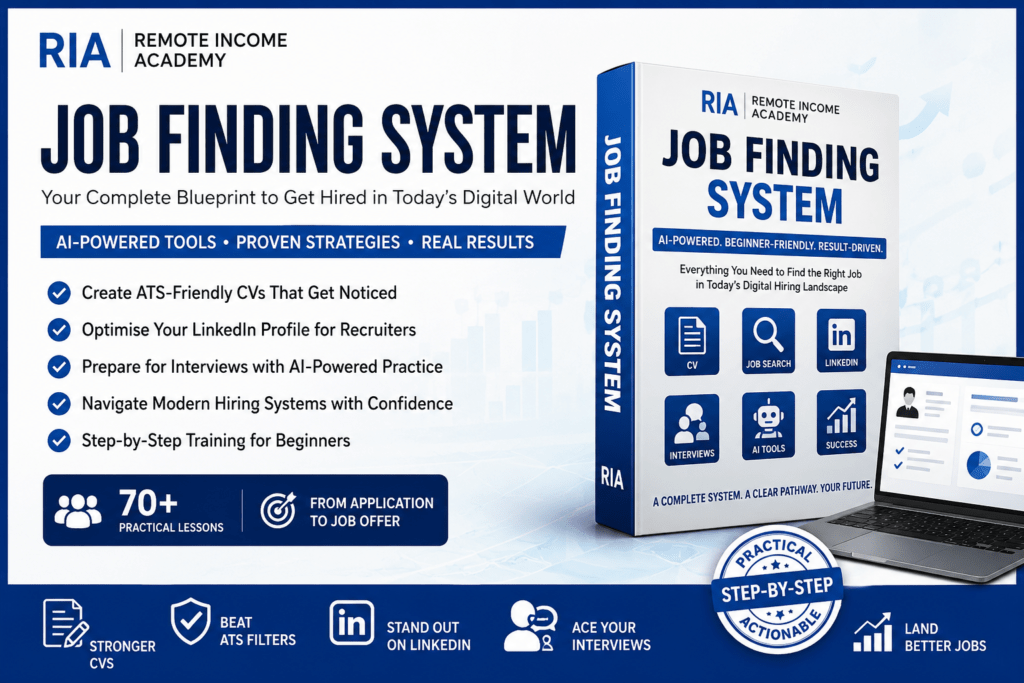
Learn how to use AI to strengthen your CV, improve your interview skills, build a professional LinkedIn profile, and navigate today’s hiring market with confidence.
The job market has changed dramatically. The sooner you understand how modern hiring systems work, the faster you’ll start seeing better results.
🚀 The Freelance Blueprint
Want to make your first $500 online using AI freelancing?
This is the exact system I recommend if you’re starting from scratch, proven to deliver results.
A simple step-by-step system that shows you how to land your first clients and build a repeatable freelance workflow you can scale.
💡 About the Author
Richard Corona is the founder of Remote Income Academy,
He helps beginners turn AI skills into real income through practical systems, workflows, and guides.
With years of hands-on freelancing experience, he focuses on helping people get results fast without confusion or guesswork.