8 Remote Skills Every Teenager Should Learn Before Leaving School.
RIA: Helping Young People Prepare for the Modern World of Work.
📌 In This Guide You’ll Learn:
✅ Why remote skills are becoming just as important as academic qualifications.
✅ The eight practical skills employers increasingly value in young job seekers.
✅ Simple ways teenagers can start developing these skills today.
✅ How parents can support career readiness without taking over.
✅ Why learning to work alongside AI creates long-term career advantages.
⏱ Reading Time: 8–9 Minutes
Important Remote Skills Every Teenager Should Learn Before Leaving School.
Remote skills for teenagers are becoming just as important as good grades. As employers increasingly value digital communication, adaptability, and AI literacy, helping young people develop these practical skills before leaving school can give them a real advantage in today’s job market.
Finding a first job today is more challenging than many parents remember. The workplace has changed, hiring has become more digital, and employers are looking for different skills than they did in the past.
For many parents, one question keeps coming up: “Is my child really prepared for today’s job market?” This is a fair question.
Schools provide valuable education, but the workplace is changing faster than ever. Employers now expect young people to arrive with more than academic knowledge. They increasingly value communication, adaptability, digital confidence, and the ability to learn continuously.
The encouraging news is that these skills aren’t reserved for university graduates or experienced professionals. Many of them can begin developing long before a teenager applies for their first job.
The goal isn’t to predict exactly what careers will look like in the future. The goal is to build skills that remain valuable no matter how technology evolves.

Preparing Young People for the Modern Workplace:
At Remote Income Academy, we believe career readiness is no longer about knowing everything. It’s about developing the confidence to learn, adapt, solve problems, and use modern digital tools effectively. The future belongs to people who learn to work alongside AI, not compete against it.
This means, whether your teenager plans to attend university, enter the workforce, explore remote work, or eventually build a freelance career, the following skills provide a strong foundation for long-term success.
Why Remote Skills Matter More Than Ever!
Many people hear the phrase remote work and immediately think of working from home. In reality, remote skills go much further than that. These remote skills for teenagers aren’t just useful for remote work—they help young people become more confident, adaptable, and employable in almost any career.
These are the professional habits, communication abilities, and digital competencies that allow someone to work effectively in today’s connected world, so even if your child never works remotely, these skills are becoming standard expectations across many industries.
Employers increasingly look for candidates who can:
- Communicate professionally online.
- Organise their own workload.
- Learn new technology quickly.
- Collaborate with others digitally.
- Solve problems independently.
- Adapt to changing tools and processes.
These abilities often distinguish successful candidates from equally qualified applicants. Let’s look at the eight skills every young person should begin developing before leaving school.
👉 If you’re looking for a complete roadmap to today’s hiring process, our AI Job Search Guide walks through every stage, from preparing applications to using AI effectively during your job search. Read: Preparing for Today’s Job Market AI Job Search Guide
1. Digital Communication:
Communication has always mattered, and today more so than ever before.
Today, much of that communication happens through digital channels.
Young people should become comfortable writing:
- Professional emails.
- Messages to colleagues.
- Online meeting invitations.
- Project updates.
- Polite follow-up messages.
Many employers notice communication skills during the hiring process long before an interview takes place.
- A clear email.
- A well-written LinkedIn message.
- A professional online profile.
These small details often create strong first impressions.

How Can Parents Help?
Encourage teenagers to write their own emails instead of doing it for them. Allow them to communicate with teachers, clubs, or volunteer organisations independently. Confidence grows through practice and confidence is important while searching for employment.
2. AI Literacy:
One of the biggest misconceptions today is that AI replaces people. In reality, employers increasingly value people who know how to use AI responsibly and effectively.
AI can help young people:
- Organise ideas
- Practise interviews
- Improve writing
- Brainstorm projects
- Explain difficult concepts
- Research careers
The important skill isn’t simply using AI. It’s knowing when to trust it, when to verify information, and how to ask better questions. Teenagers who develop good AI habits today will be better prepared for tomorrow’s workplace.
👉 Read: How to Use AI to Get a Job (Step-by-Step AI Job Search System)
3. Research and Critical Thinking:
Information has never been easier to find. BUT Reliable information has never been more important.
Employers appreciate people who can:
- Compare sources.
- Evaluate information.
- Identify reliable advice.
- Solve problems logically.
- Make informed decisions.
AI can produce answers quickly. Critical thinking helps determine whether those answers are actually useful. Parents can encourage this in their teenagers by asking questions such as:
- “Why do you think that’s correct?”
- “Where did you find that information?”
- “Is there another way to solve this problem?”
These conversations develop independent thinking.
4. Time Management and Personal Responsibility:
One challenge many young people face when entering the workplace is managing their own time. Without teachers reminding them about deadlines, they suddenly become responsible for organising themselves.
Simple habits make a big difference:
- Planning tomorrow’s tasks today
- Using digital calendars
- Setting reminders
- Prioritising important work
- Finishing one task before starting another
These habits become especially valuable in remote and hybrid workplaces where employees often work with greater independence.
Why Do These Skills Create Long-Term Career Advantages?
Notice that none of these skills depends on a particular software program or technology.
- Tools will change.
- Employers will change.
- Industries will evolve.
However, people who communicate well, solve problems, manage themselves effectively, and continue learning remain valuable throughout their careers. These are transferable skills, which means they travel with your child wherever their career takes them. As you’ll see, the best remote skills for teenagers aren’t tied to one career. They’re lifelong abilities that employers value across many industries.

5. Adaptability and a Willingness to Keep Learning: (*Good Job Ethics)
One of the biggest differences between today’s workplace and the one many parents entered is the speed of change. New software appears every year. Industries evolve. AI tools improve almost monthly. Job roles that didn’t exist a few years ago are now creating exciting career opportunities.
Because of this, employers increasingly value people who enjoy learning rather than those who believe they already know everything. A teenager who is curious, open to feedback, and willing to develop new skills will often outperform someone with stronger qualifications but a fixed mindset. Encourage your child to see learning as something that continues long after school or university.
The most successful professionals never stop learning—they simply become better at learning.
How Can Parents Help?
You don’t need to know every new technology yourself. Instead, encourage curiosity. For example, if your teenager discovers a new AI tool, asks about digital careers, or wants to try an online course, support that curiosity rather than dismissing it as “just another app.”
6. Building a Professional Digital Presence:
Whether we like it or not, many first impressions now happen online. Recruiters often search for applicants before inviting them to interviews. Employers may look at a LinkedIn profile, a portfolio, or other professional online activity.
This doesn’t mean teenagers need to become influencers. It means they should begin thinking about how they present themselves online. A simple LinkedIn profile, examples of school projects, volunteer work, creative hobbies, or certificates can all help build credibility.

A professional digital footprint shows initiative and helps employers understand who someone is beyond their CV.
They Can Start Small:
A teenager doesn’t need years of experience to build an online presence. They can begin with:
- Volunteer work.
- School achievements.
- Community projects.
- Online certifications.
- Creative work.
- Coding projects.
- Writing samples.
- Design portfolios.
Small steps taken early often become valuable assets later.
READ Related Guide: Helping Young Adults Build a Professional Digital Presence.
7. Collaboration and Teamwork:
Many young people associate teamwork with school projects. In reality, modern teamwork looks very different. Today’s professionals collaborate through:
- Video meetings
- Shared online documents
- Messaging platforms
- Project management tools
- Cloud-based collaboration
Even remote workers rarely work completely alone. Employers want people who communicate respectfully, contribute ideas, meet deadlines, and support colleagues. These habits can begin developing long before someone’s first job.
Sport, volunteering, clubs, debating societies, student councils, and community projects all teach valuable teamwork skills.

8. Problem Solving and Taking Initiative:
Perhaps the most valuable skill of all is learning to solve problems. Employers appreciate people who don’t simply point out problems—they look for possible solutions.
That doesn’t mean having every answer.
- It means asking good questions.
- Trying different approaches.
- Learning from mistakes.
- Showing initiative.
For example, instead of saying: “I don’t know how to do this.”
A more valuable habit is saying: “I’ve tried two possible solutions. Could you help me understand which one is better?”
That simple shift demonstrates maturity, curiosity, and responsibility, and those qualities often leave lasting impressions on employers.
The Good News for Parents!
Reading this list might feel overwhelming at first but the good news is that your child doesn’t need to master every skill before leaving school. Career readiness isn’t about being perfect.
It’s about building confidence one step at a time.
- Every conversation about careers…
- Every opportunity to volunteer…
- Every online course…
- Every small responsibility…
Helps prepare young people for the world they’ll soon enter. The goal isn’t to create the “perfect candidate.” The goal is to help your child become adaptable, capable, and eager to learn.
Because those qualities never go out of style.
Try This Practical AI Exercise:
Ask ChatGPT to Become a Career Coach…
Teenagers can use this prompt to identify areas for improvement.
Prompt: “Act as a career coach for a teenager preparing for their first job. Based on these eight remote skills—digital communication, AI literacy, critical thinking, time management, adaptability, professional digital presence, teamwork, and problem solving—ask me questions to assess my strengths and weaknesses. Then suggest three practical actions I can complete this month to improve my career readiness.”
This turns AI into a learning partner rather than someone who simply provides answers.
24-Hour Action Plan:
You don’t need to transform your child’s future overnight. Instead, choose one small action today.
For example:
- ✅ Create or update a LinkedIn profile.
- ✅ Complete a free online AI or digital skills course.
- ✅ Write a professional email without assistance.
- ✅ Organise a weekly study or learning schedule.
- ✅ Volunteer for a community project.
Small habits repeated consistently build lifelong confidence. By developing these remote skills for teenagers early, parents can help young people build confidence and prepare for opportunities that continue to evolve.
🚀 Help Them Start Their Career With Confidence!
If this guide has given you ideas, the next step is following a structured system. The AI Job Search System teaches practical, beginner-friendly strategies for creating stronger applications, preparing for interviews, using AI responsibly, and building confidence in today’s digital job market.
Whether you’re helping your child, supporting a graduate, or looking for work yourself, it provides a clear roadmap from preparation to employment.
👉 Explore the AI Job Search System below:
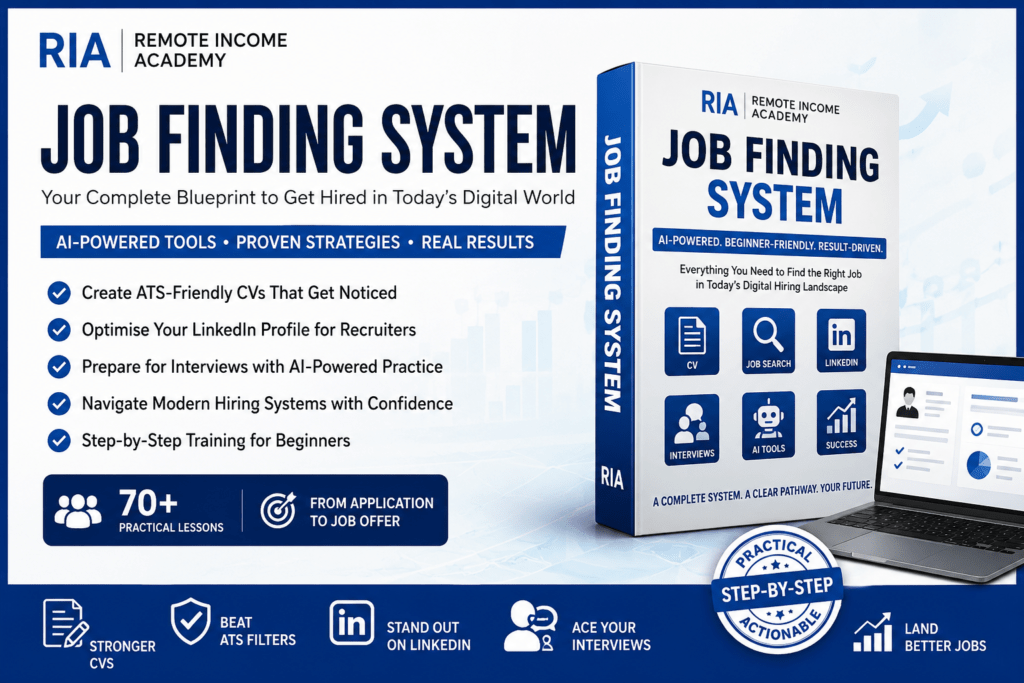
Learn how to use AI to strengthen your CV, improve your interview skills, build a professional LinkedIn profile, and navigate today’s hiring market with confidence.